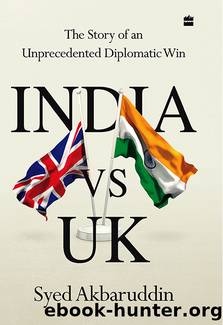
India vs UK by Syed Akbaruddin
Author:Syed Akbaruddin
Language: eng
Format: epub
Tags: null
Publisher: HarperCollins India
Published: 2021-11-15T00:00:00+00:00
There are matters that need to be addressed immediately. The voting for seats on the ICJ is by secret ballot. However, in multilateral diplomacy, there are very few secrets. More so in the case of the Security Council. Like a cosy club, the fifteen members have a fairly good idea where each stands on an issue. The more engaged Permanent Representatives from amongst Council members are usually able to fathom even the secrets of voting in the Council based on their conversations and a bit of scouting by their delegates. I set out to seek the insights of a few of them.
âSomething fishy was going on,â says a Security Council diplomat summing up the dayâs proceedings. Having sat through all the votes in the Council, he had a ringside view of the goings on. âIndia is a large and respected country with many friends. However, you were done in by your friends pursuing loftier goals,â he says, pointing to a shift in two Council votes after the lunch recess. âThe total votes remained as they were in the round previous to that ... but two votes were shifted from you to another candidate from your region by a regional group to help a candidate from their region,â is his assessment. âIt was not that they liked India less; it was simply a case that they liked their region more,â is his pithy conclusion, alluding to Brutusâs justification for turning against Julius Caesar. It makes sense. It seems to fit in with the facts and it is in tune with our own concerns about group loyalties. Yet, it is only one sophisticated diplomatâs hypothesis with no corroboration. The answer to which two countries in the Security Council shifted their votes away from India perhaps lies at my next port of call.
Since most UN missions are located very close to each other, and such is my eagerness to better understand the Council dynamics, I visit another colleague less than ten minutes after he agrees to meet me at the end of a long day of voting. In his assessment, âThe distillation process is over. The choice now is between a developing country that is clearly on the rise and a developed country which had contributed much but is past its best. Complicating issues of individual friendships, regional interests and prior commitments, which weighed in the earlier multi-cornered votes, are no longer in the mix. You can count on us now.â
When, half in jest, I query that he seems to emphasize on the now, he parries with, âYou need to appreciate the dynamics of evolving situations. Now, even your good friendsâold and newâRussia and Japan are not with you.â Then he lowers his voice and with a mischievous grin adds, âI know this as, unlike in the General Assembly, Council delegates are seated much closer. It helps us understand each other better.â He then concludes with, âLet me assure you: irrespective of the past, we will be with you all the way now.â
It
Download
This site does not store any files on its server. We only index and link to content provided by other sites. Please contact the content providers to delete copyright contents if any and email us, we'll remove relevant links or contents immediately.
| Anthropology | Archaeology |
| Philosophy | Politics & Government |
| Social Sciences | Sociology |
| Women's Studies |
Born to Run: by Christopher McDougall(7127)
The Leavers by Lisa Ko(6948)
iGen by Jean M. Twenge(5416)
Sapiens by Yuval Noah Harari(5372)
Spare by Prince Harry The Duke of Sussex(5197)
The Kite Runner by Khaled Hosseini(5180)
Machine Learning at Scale with H2O by Gregory Keys | David Whiting(4313)
Bullshit Jobs by David Graeber(4192)
Never by Ken Follett(3957)
Goodbye Paradise(3810)
Livewired by David Eagleman(3775)
Fairy Tale by Stephen King(3399)
A Dictionary of Sociology by Unknown(3085)
Harry Potter 4 - Harry Potter and The Goblet of Fire by J.K.Rowling(3074)
The Social Psychology of Inequality by Unknown(3031)
The Club by A.L. Brooks(2926)
Will by Will Smith(2920)
0041152001443424520 .pdf by Unknown(2846)
People of the Earth: An Introduction to World Prehistory by Dr. Brian Fagan & Nadia Durrani(2739)
